CyberArk pricing is negotiated for many enterprise purchases, but selected CyberArk-sold AWS Marketplace packages have public prices. One Standard Privilege Cloud listing costs $44,712 for 25 users over 12 months. That isn't a universal CyberArk per-user rate. The package, license scope and purchase channel determine what the number means.
What's changed for buyers is the brand. Palo Alto Networks completed its acquisition of CyberArk in February 2026 and introduced the Idira identity security platform in May 2026. You'll still encounter CyberArk product names in contracts, marketplace listings and older documentation, while current product pages use Idira branding. Ask your account team to map the quoted SKU to the current product and entitlement before comparing offers.
CyberArk covers several different jobs: privileged session control, endpoint privilege elevation, developer cloud access, machine secrets and workforce authentication. Comparing their prices as though they're one interchangeable subscription won't give you a usable budget. The examples below separate listed package amounts from the questions only a written quote can answer.
How much does CyberArk cost?
CyberArk costs depend on the product and the contract. A single headline number can't cover both. The following CyberArk-sold AWS Marketplace listings show public 12-month amounts for named packages, while private offers can differ. The amounts were visible on October 31, 2026, and shouldn't be treated as a company-wide rate card.
- Privilege Cloud Standard, AWS listing$44,712 per 12 months for 25 users
- Privileged access management package
- 25-user block on a 12-month contract
- Private offers available per the listing
- Endpoint Privilege Manager, AWS listing$11,520 per 12 months for 100 users
- Endpoint privilege management
- 100-user block on a 12-month contract
- Secure Cloud Access, AWS listing$2,400 per 12 months for 5 users
- Secure developer access
- Multi-cloud access with zero standing privileges
- DevSecOps Secrets Manager, AWS listing$23,328 per 12 months for 20 users
- Secrets Manager package
- 20-user block on a 12-month contract
- Workforce Identity Standard, AWS listing$12,528 per 12 months for 100 users
- Workforce identity access
- 100-user block; Workforce Password Management is priced separately
CyberArk-sold AWS Marketplace examples, checked October 31, 2026. Each is a specific listing, not a promise of availability or a standardized quote. Other entitlements and negotiated offers may differ.
Listings checked on October 31, 2026: Privilege Cloud, Endpoint Privilege Manager, Secure Cloud Access, DevSecOps Secrets Manager and Workforce Identity on AWS Marketplace.

The prices are not tiers of one product. Privilege Cloud Standard is a privileged access package, Endpoint Privilege Manager addresses local privilege on devices and Workforce Identity covers employee authentication. If you add the amounts together without validating overlap, you'll double count some needs and leave others unpriced.
For a simple comparison, the listed Privilege Cloud package works out to $1,788.48 per listed user per year ($44,712 divided by 25). That's an arithmetic equivalent of a fixed package, not evidence that CyberArk sells individual seats at that price. Endpoint Privilege Manager's listed package works out to $115.20 per listed user per year ($11,520 divided by 100). Those two figures don't describe comparable rights.
Why is there no single CyberArk pricing plan?
There isn't one CyberArk pricing plan because privileged accounts, endpoints, developers, applications and workforce users represent different security jobs. The current Idira portfolio describes separate privileged access, endpoint and machine identity capabilities. A quote must identify which control you're buying and which population is licensed. The names on the AWS listings (Privilege Cloud, Secure Cloud Access, Workforce Identity) don't all appear on the current Idira product pages, which use names such as Idira Privileged Access Manager, Idira Endpoint Privilege Manager and Idira Secrets Manager.
The name on the purchase order matters. A team that needs recorded administrator sessions shouldn't assume an endpoint elevation license includes a vault or session broker. A developer team seeking short-lived cloud access shouldn't assume a Workforce Identity subscription covers its cloud permission workflow. Likewise, storing an application secret doesn't establish who approved the service account or whether that application still needs access.
Privilege Cloud and privileged access management
Privilege Cloud is the PAM package with a public AWS price, so it's the natural starting point. The current Idira PAM description covers credential vaulting, session isolation, just-in-time access and control over sensitive administrative actions. The AWS listing for Standard Privilege Cloud identifies a named 25-user package, but it doesn't establish the price of every configuration.
An IT lead should inventory human administrators, shared administrative identities, target systems, external vendors and session requirements separately. The number of people who log in isn't necessarily the same as the number of accounts or systems being protected. Ask the seller to define the billable unit rather than assuming it's one license per protected credential.
A realistic evaluation starts with a firewall administrator who needs a recorded session and a contractor who needs temporary access. Those two cases raise different licensing questions: who counts as a user, and which sessions are recorded. Specify whether the proposal includes credential rotation, session recordings, access approvals, third-party access and the retention settings your audit team expects. If the quote says PAM but doesn't identify those entitlements, the line item isn't ready for approval.
Endpoint Privilege Manager
Endpoint Privilege Manager addresses a different control: removing standing local administrator privileges and allowing policy-based elevation for approved applications and tasks. The current Idira EPM page also describes an audit trail for privileged endpoint activity. Its AWS listing shows a 100-user package, not a general PAM license.
For an endpoint pilot, count managed devices and users separately, because they're rarely the same number. Include shared workstations, servers, contractors and multiple devices per employee in the discovery worksheet. Then ask which count actually drives the order. A software developer who needs to install an approved tool is a different use case from a database administrator who needs a recorded privileged session on a production server.
Check how the product handles emergency elevation, application exceptions, policy rollout, offline endpoints and evidence export. The technical team should confirm whether the quoted configuration covers the operating systems you run and whether support for servers is included in the same commercial line. Marketing pages describe capabilities, but what you're entitled to depends on your order.
Secure Cloud Access for developers
Secure Cloud Access focuses on temporary developer access across cloud environments. CyberArk's AWS Marketplace listing describes multi-cloud access, zero standing privileges and CLI or web workflows. Its public package has a small listed user population, but don't extrapolate it into an enterprise rate.
Consider a platform engineer who occasionally needs elevated access to a production cloud account. The buyer's question isn't just how many engineers exist. It's which clouds, roles and access paths need coverage, whether approvals are required and how the access evidence will be exported. Include service principals and automation identities in the architecture discussion and don't assume a human developer license covers them.
A pilot should show that a developer can request access, get the minimum entitlement, finish the task and leave a record of what happened. If it can't, the product isn't ready for your environment. Ask for an explicit boundary between this product and the privileged session product in your quote. Otherwise you'll buy overlapping access controls while leaving workload identities out of scope.
Secrets Manager and DevSecOps
Secrets Manager secures credentials used by applications, automation and workloads. Idira's current machine security pages describe centralized storage, retrieval and automated rotation across cloud and hybrid environments. A CyberArk DevSecOps marketplace listing has its own 20-user package, but that listing alone doesn't tell you how your production workload inventory would be licensed.
Build a separate list of application identities, environments, secret stores, rotation owners and dependencies. One payroll integration may rely on several credentials across a scheduler, database and API. The commercial scope has to follow the real architecture, not a guess based on how many developers maintain it.
Ask whether the quote includes managed secrets, workload authentication, integrations with existing vaults, high availability and the audit events needed by your security team. Also ask who performs the application changes required for safe credential rotation. Buying a vault doesn't automatically make every dependent application rotation-ready.
Workforce Identity
Workforce Identity is an identity and access offering, and it isn't a substitute for privileged session management. CyberArk's AWS listing describes workforce authentication, authorization and application access. The listed Standard package covers a named 100-user population, and the same listing prices a Workforce Password Management dimension separately, at $14,400 for 200 users over 12 months.
If the requirement is SSO or MFA for employees, define the application estate, user types, lifecycle ownership and support model. If the requirement is to control privileged administrator actions, compare the PAM scope separately. Combining both in a platform proposal may make sense, but only if the seller provides a line-by-line entitlement map.
What makes a CyberArk quote more expensive?
A CyberArk quote can grow when you expand the licensed population, add product families, require more deployment work or buy additional services. Those are planning categories, and they don't mean every CyberArk agreement charges for each item. Request a priced bill of materials and separate one-time work from recurring subscriptions.
| CyberArk cost driver | What to count | What to request in writing |
|---|---|---|
| Privileged access | Admin users, privileged identities, target systems and external users | Licensed metric, included session controls and scope limits |
| Endpoint elevation | Employees, devices, servers and shared endpoints | Billable unit, OS coverage and exception policy scope |
| Cloud developer access | Engineers, cloud accounts, environments and workflows | Covered clouds, approvals, access duration and audit export |
| Machine secrets | Applications, workloads, credentials and secret stores | Licensed dimension, rotation features and integration scope |
| Workforce identity | Employees, contractors and application integrations | Included authentication features and user blocks |
| Services | Design, migration, training, deployment and handover | Fixed-fee statement of work, acceptance criteria and change control |
| Operations | Support, log storage, evidence export and recovery | Support tier, retention commitments and operational responsibilities |
License scope comes first. If the account team calls something a privileged user, ask whether that means a named administrator, a shared account, a service identity or a particular product entitlement. Put the definition beside the quantity in the quote, because it's the definition that decides the price. A clean unit definition prevents an apparent discount from masking a narrower scope.
Implementation comes next. A vendor subscription won't necessarily include onboarding every target system, rewriting credential-dependent jobs or establishing approval workflows. Build a work breakdown with owners for discovery, policy design, rollout, exceptions, evidence collection and production acceptance. If a partner is involved, get a separate statement of work with milestones and handover documentation.
Operations matter after launch. Someone has to own new privileged identities, stale accounts, emergency access, session evidence, policy exceptions and failed rotations. Those activities consume staff time even when the software contract doesn't itemize them. Don't call the platform fully deployed until the operating model is staffed and tested.
How should you calculate CyberArk total cost of ownership?
CyberArk total cost of ownership should include the actual license quote, implementation, internal operations, infrastructure where applicable and renewal changes. Start with a listed package only as a reference point, then replace it with the negotiated quote. Don't multiply a marketplace per-user equivalent into a larger organization's budget.
A fixed-package illustration can show the difference between a posted amount and a complete budget. The calculator uses only the observed AWS Privilege Cloud package, with no assumed add-ons or discounts.
Illustration of a single published listing only. It excludes implementation, support differences, taxes and any additional infrastructure. Get a fresh written offer before budgeting.
Use a procurement worksheet with separate cells for each cost category. The table below is a skeleton: fill each line from your own written quotes. Don't insert a zero for a missing quote. Mark it unquoted until the seller confirms whether the item is included, excluded or separately priced.
| CyberArk budget line | Amount (USD) | Owner | Evidence to collect |
|---|---|---|---|
| Privilege Cloud subscription | Actual quote pending | Procurement | SKU, license count and signed offer |
| Other Idira modules | Actual quote pending | Security architect | Feature-to-SKU mapping |
| Implementation and migration | Actual SOW pending | IT program lead | Milestones, acceptance tests and scope |
| Internal operations | Internal estimate pending | IT operations | Named owners and hours budget |
| Infrastructure and retention | Scope-dependent | Cloud or platform team | Hosting, storage and recovery design |
| Renewal adjustment | Contract-dependent | Finance | Renewal clause and approved baseline |
A defensible model records the currency, purchase channel, contract dates, unit, volume, included features and excluded services for each line. Finance can then compare annual recurring cost with the one-time implementation budget, and security can see what isn't covered. Security can confirm that the purchased controls cover the intended risk, rather than approving a cheaper quote that omits a necessary capability.
What CyberArk contract terms should you check?
CyberArk contract review should confirm the exact entitlement, duration, renewal mechanics, data access and support obligations. AWS Marketplace's listed packages use a 12-month contract display and warn that entitlements expire if a contract isn't renewed or replaced. That statement isn't a substitute for the signed order, the current vendor terms and any negotiated amendments.
Start with the order of precedence: it settles any conflict between documents. Identify which master agreement, order form, marketplace terms, data processing terms and statement of work govern the purchase. Record the controlling version and have legal review any inconsistency. Don't infer a standard auto-renewal period or termination notice from a pricing article, including this one.
Then test the exit path, and don't leave it for renewal week. Your team should know how to retrieve recordings, audit logs, privileged account inventories and configuration evidence before access ends. Define who owns credential rotation and emergency access during migration. If a SaaS entitlement ends while a legacy application still depends on the access workflow, the operational risk may be larger than the remaining subscription value.
How do you negotiate a CyberArk quote fairly?
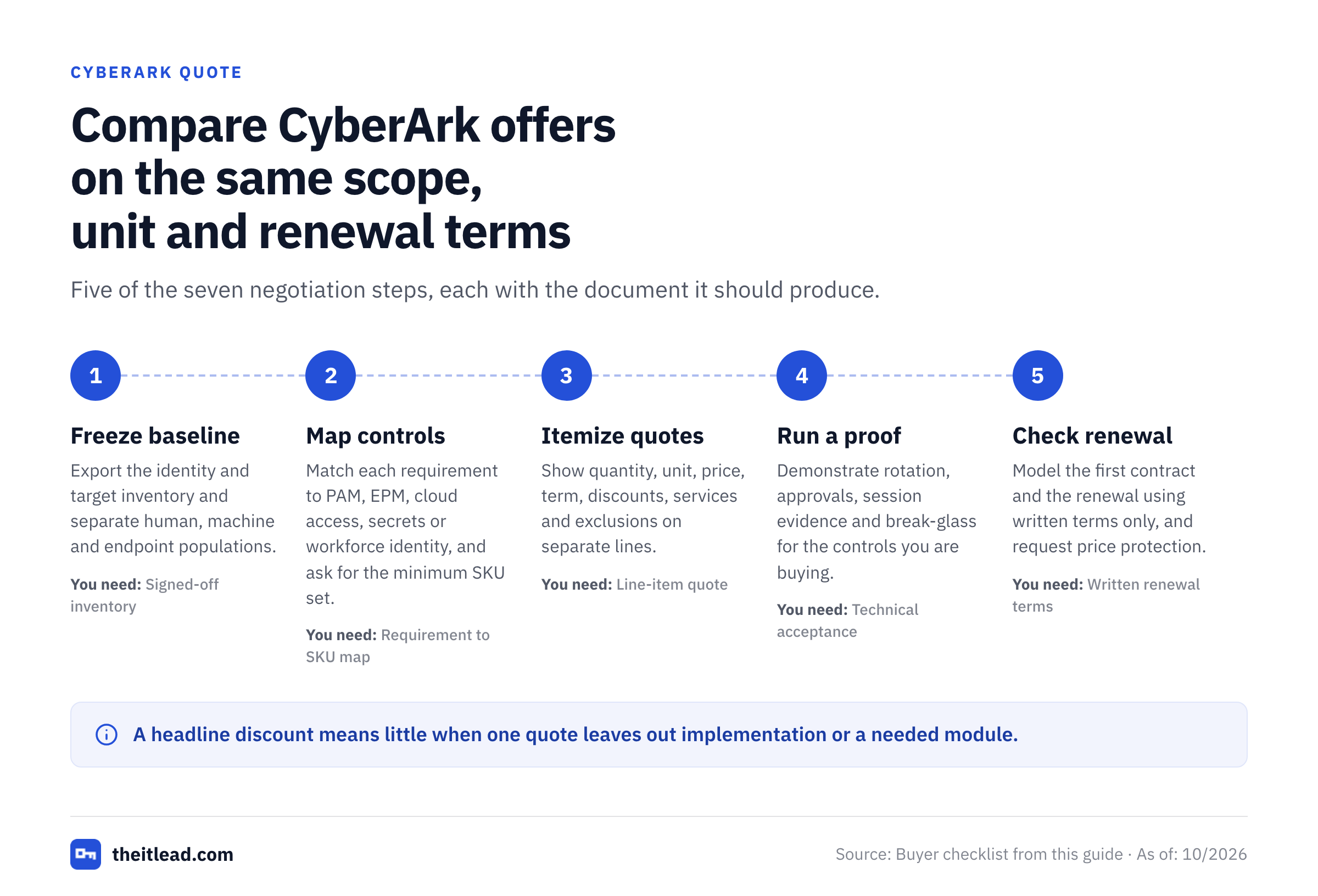
A fair CyberArk negotiation compares the same control scope, licensed metric and service obligations across offers. Frankly, a headline discount isn't meaningful when one quote excludes implementation or a needed module. Use a requirements matrix that security, IT operations, procurement and finance all sign off.
- Freeze the baseline. Export the identity and target inventory, record exceptions and separate human, machine and endpoint populations.
- Map controls to products. Identify which requirement needs PAM, EPM, cloud access, secrets or workforce identity. Ask for the minimum SKU set that covers the requirements.
- Request itemized quotes. Show quantity, unit, annual or total price, term, discounts, services and exclusions on separate lines.
- Run a technical proof. Demonstrate credential rotation, approvals, session evidence and break-glass procedures for the controls you're actually buying.
- Price the rollout. Ask the implementer to name integrations, migration assumptions, customer responsibilities and acceptance tests.
- Compare renewal exposure. Model the first contract and the following renewal using only written terms. Anything that isn't in writing doesn't count. Request price protection and expansion rates where needed.
- Document the decision. Keep the approved scope, final quote, security sign-off and owner of each exception in the procurement record.
The strongest bargaining position is a clearly scoped alternative. It isn't an unsupported internet price. BeyondTrust and Delinea can be evaluated for relevant PAM use cases, but compare their coverage and services before you compare prices. Our CyberArk vs BeyondTrust comparison and the privileged access management software roundup show how those scopes line up. A cheaper password vault alone isn't necessarily an alternative to session isolation and endpoint privilege controls.
Which CyberArk product should you buy?
The right CyberArk product depends on the access event you're trying to control. Privileged administrator sessions, local elevation, developer cloud permissions, machine credentials and workforce logins need different evidence and ownership. The smallest purchase that holds up covers the specific workflow, and it doesn't treat every identity as the same billable unit.
- Vault privileged credentials and record administrator sessionsEvaluate Privilege Cloud or the current Idira PAM offering; confirm exact session and rotation entitlements.
- Remove standing local administrator rights from workstationsEvaluate Endpoint Privilege Manager; confirm endpoint and user licensing.
- Grant temporary developer access to cloud infrastructureEvaluate Secure Cloud Access; confirm cloud and CLI workflows.
- Control application secrets and credential rotationEvaluate Secrets Manager; inventory workloads and rotation dependencies.
- Provide workforce SSO and authenticationEvaluate Workforce Identity; keep it separate from PAM session requirements.
- Track human ownership and attestations for service accountsUse a dedicated ownership review workflow alongside PAM; it doesn't replace vaulting or rotation.
An access ownership review is a complementary process, and it isn't another PAM license. A team may need to prove who approved a service account even when its password is already vaulted. The service account ownership matrix and service account audit checklist show how to organize those decisions and evidence.
Where does a service account ownership review fit?
A service account ownership review sits beside CyberArk rather than inside the price comparison. The person running the program still needs a named business owner, an independent reviewer and a record of the decision to retain or change access. Credential rotation alone doesn't establish that the permission remains justified.
For a lightweight workflow, import a service account inventory, nominate owners, collect attestations and preserve an audit trail. The IT Lead's own service-account ownership workflow focuses on that CSV-based ownership review. It doesn't rotate passwords, discover accounts or sync with a live directory. The service account inventory template is a practical starting point for preparing the source data.
What should you ask CyberArk sales before signing?
Ask CyberArk's sales team for an entitlement map, the licensed unit and a written total-cost proposal. The technical and commercial answers should describe the same scope. Use this checklist during procurement and save the responses with the final order, so you've got a record of what the seller said.
- Identify each current Idira or legacy CyberArk product and its exact SKU.
- Define the billable user, account, endpoint or workload for every line.
- List included controls, exclusions and any required add-on modules.
- Confirm implementation responsibilities, dependencies and acceptance tests.
- Confirm support level, log retention, evidence export and recovery expectations.
- Record term, renewal notice, price changes, expansion rules and exit assistance.
- Keep the dated quote and approved identity inventory with the purchase decision.
A vendor response that says pricing is customized isn't enough. The quote must show which identities are protected, what the security team can demonstrate and what finance will pay. That's the test of a real quote. That's the minimum evidence needed for a credible buying decision.
CyberArk pricing FAQ
CyberArk pricing questions usually come down to the published package amount, the unit being licensed and whether a separate product is required. The answers below distinguish the visible marketplace examples from enterprise contracts that still need a custom quote.
Does CyberArk publish pricing?
Only for selected packages. CyberArk-sold AWS Marketplace listings show 12-month prices for five named packages, while the Idira product pages list no prices and point to a sales conversation. Request a written quote for your actual scope.
How much is CyberArk Privilege Cloud?
A Standard Privilege Cloud AWS listing displayed $44,712 for 25 users over 12 months when checked October 31, 2026. That's one package, not a universal price per administrator.
Is CyberArk priced per user or per account?
CyberArk licensing depends on the product and the exact order. Some marketplace descriptions identify users, but you'll want to confirm how privileged identities, endpoints and workloads are counted in your quote.
Does CyberArk Endpoint Privilege Manager cost extra?
On AWS Marketplace it is a separate listing from Privilege Cloud, with a 100-user package at $11,520 for 12 months, so budget it as its own line unless your quote bundles it. A bundled enterprise proposal may use different terms.
Is CyberArk now called Idira?
Partly. Palo Alto Networks introduced Idira in May 2026 after acquiring CyberArk, and current product pages use Idira branding. CyberArk still appears in existing product and marketplace names.
Can I estimate a CyberArk enterprise contract from marketplace prices?
Marketplace package prices can provide reference points, but they don't establish enterprise volume discounts, implementation costs or the licensed metric. Use a line-item quote and a scoped inventory for budgeting.