CyberArk vs BeyondTrust comes down to where privileged access creates the most operational risk. CyberArk, which is now presented through Palo Alto Networks' Idira identity security platform, is a strong candidate for organizations designing a broad vaulting, privileged-session, and identity-security program. BeyondTrust is a strong candidate when Password Safe, third-party access, and endpoint privilege controls must work together in day-to-day IT operations. Neither vendor should win just because it's got a longer feature list.
The most important 2026 change is the naming, and it's one you'll certainly meet in procurement. Palo Alto Networks completed its CyberArk acquisition on February 11, 2026. Its current identity security platform is called Idira, built on CyberArk's legacy. BeyondTrust markets its own Pathfinder Platform. Ask for the exact current product and entitlement names on every proposal. Don't assume an older CyberArk or BeyondTrust SKU includes every feature you've seen in a platform presentation.
- Choose CyberArk/Idira when a vault-first PAM program, broad identity scope and centralized privileged-session control are the primary buying goals.
- Choose BeyondTrust when Password Safe, privileged vendor access and endpoint least privilege are the most important operational workflows.
- Both offer credential controls, session evidence, endpoint privilege management and vendor access; verify exactly which modules a quote includes.
- BeyondTrust directs Password Safe and Privileged Remote Access buyers to custom quotes. A specific CyberArk Privilege Cloud Standard AWS Marketplace offer is published, but is not a universal price list.
- The decisive proof is a live pilot with an owned account inventory, recorded access requests, session evidence and tested offboarding.
 Start with CyberArk/Idira for a vault-first program
- Broad vaulting, rotation and session isolation across a wide identity program.
- Zero standing privileges and cloud access sit in the same platform.
- Confirm exact Idira SKUs, since product names are changing.
 Start with BeyondTrust for vendor access and endpoints
- Privileged Remote Access gives VPN-free vendor sessions with credential injection.
- Password Safe and Remote Access come as one Total PASM bundle.
- Endpoint Privilege Management covers Windows, Mac and Linux.
Is CyberArk better than BeyondTrust for privileged access management?
Neither vendor is clearly better in every category. CyberArk/Idira emphasizes a broad identity-security operating model built around privileged access, vaulting, session isolation and zero standing privileges. BeyondTrust brings Password Safe, Privileged Remote Access and Endpoint Privilege Management into a portfolio aimed at controlling credentials, vendor connections and local administrative rights. Both vendors describe capabilities in all these areas.
The practical distinction is which control you need to make reliable first, and that's a question about your risks, not the vendors. If you're dealing with a sprawling estate of privileged identities and inconsistent session oversight, evaluate Idira's vaulting and privileged-access workflow first. If external maintenance contractors, endpoint admin rights and session handoffs dominate your incidents, you'll want to evaluate BeyondTrust's corresponding products first. These are buyer-fit judgments based on documented product positioning, and they aren't a benchmark showing that one product outperforms the other.
| Tool | Core PAM | Vendor access | Endpoint privilege | Platform | Public pricing | Audit evidence |
|---|---|---|---|---|---|---|
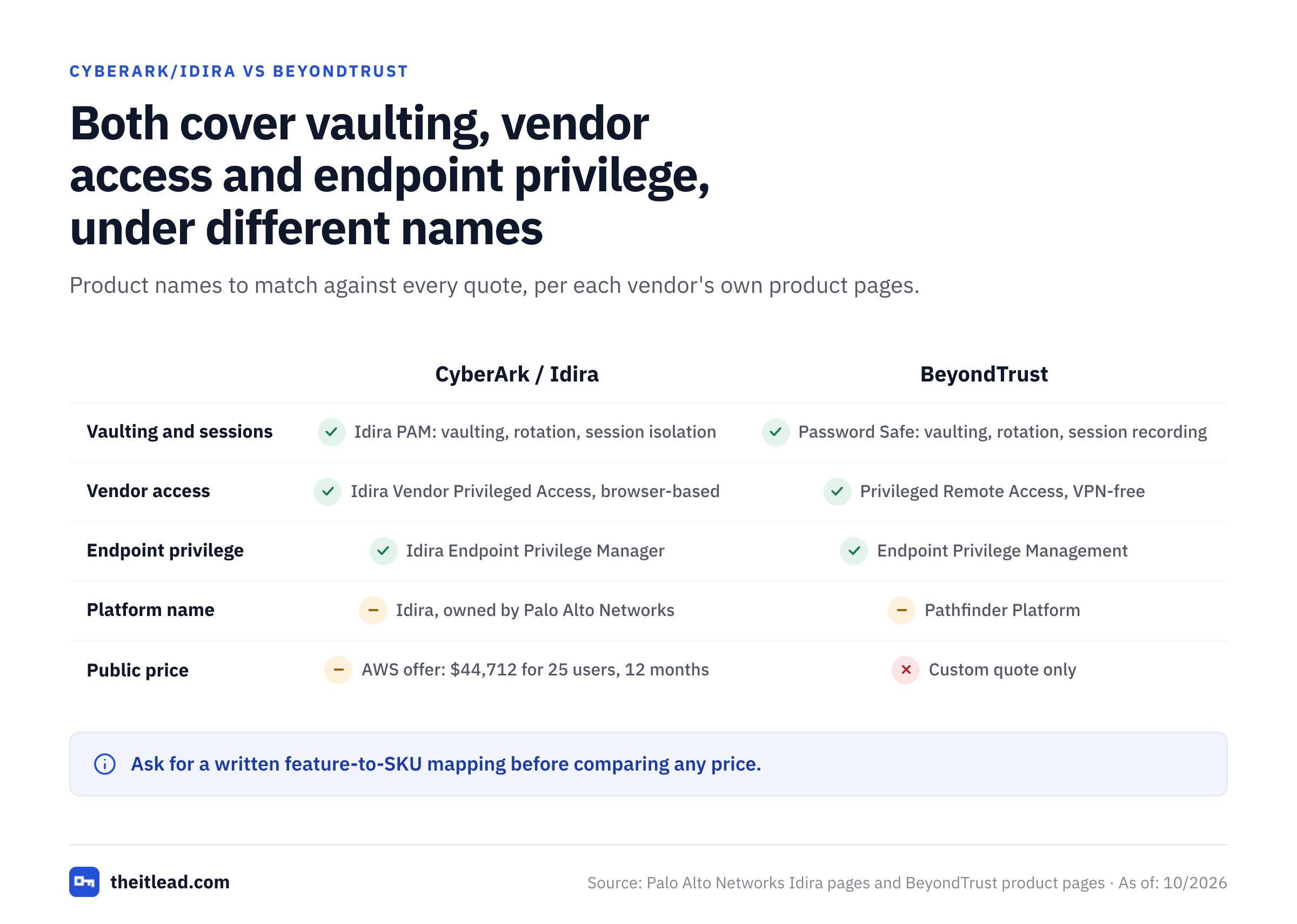
| CyberArk (Idira) | Idira PAM: vaulting, rotation, session isolation | Idira Vendor Privileged Access | Idira Endpoint Privilege Manager | Idira, owned by Palo Alto Networks | AWS Marketplace offer: $44,712 for 25 users | Vault and session evidence |
| BeyondTrust | Password Safe: vaulting, rotation, session recording | Privileged Remote Access | Endpoint Privilege Management | Pathfinder Platform | Custom quote only | Vault, session and endpoint evidence |
What IT should prove for each row: discover, onboard and revoke a real privileged account; approve, record and end an external session; remove standing admin rights without breaking approved work; retrieve and rotate a representative application secret; and export records tied to a named owner and approval.
Shortlist verdict: Start with the workflow that would cause the largest security or operational failure if nobody managed it. Then ask both vendors to show it working against the same targets, identity types, and evidence requirements.
How do the CyberArk and BeyondTrust products line up?
The comparison isn't one application against another. It's a portfolio comparison. A PAM vault, a vendor remote-access gateway, endpoint privilege software and a machine-secrets service solve related but different problems. Treating them as interchangeable leads to expensive scope mistakes, and that's easy to do.
CyberArk products under the Idira brand
Palo Alto Networks describes Idira as an identity security platform for human, machine and agentic identities. Its PAM material describes vaulting and rotation, privileged-session isolation, zero standing privileges, cloud and infrastructure access, endpoint privilege controls and third-party access. The current vendor-access offering is described as Idira Vendor Privileged Access. Endpoint controls are described as Idira Endpoint Privilege Manager.
The brand transition matters in procurement. A familiar CyberArk product name in an older proposal doesn't by itself establish the current licensed feature set. Ask the seller to map legacy names to current Idira products, say which controls are included, and document the support and migration path for the components you've already installed. Existing CyberArk customers are told they can continue using the platform during the transition, but that isn't a substitute for checking a new order form.
BeyondTrust Password Safe, Privileged Remote Access and Endpoint Privilege Management
BeyondTrust Password Safe covers privileged credential discovery, onboarding, vaulting, rotation, secrets, session management and audit reporting. Privileged Remote Access is oriented toward brokered access by internal teams and external vendors, including session evidence and credential injection. Endpoint Privilege Management is aimed at removing local administrator rights and allowing policy-controlled application elevation. The Pathfinder Platform brings these product lines under a shared identity-security positioning.
BeyondTrust also offers a Total PASM bundle combining Password Safe and Privileged Remote Access. That matters if you want both credential governance and vendor access. Compare the bundle against the individual components, not against an all-inclusive platform. Ask what's still licensed separately, including endpoint controls, support and additional identity-security capabilities.
Which vendor handles password vaulting and session monitoring better?
CyberArk and BeyondTrust should both be evaluated as credible options for privileged password and session management. Idira's own PAM page describes automated credential vaulting and rotation alongside session isolation and monitoring. BeyondTrust's Password Safe documentation describes automated discovery and onboarding, password rotation, privileged session recording and searchable audit records. What you can establish without a controlled test is product scope, not measured effectiveness.
Begin a vault pilot with an actual inventory, not an idealized demo account. You'll want a Windows administrator, a Linux service account, a network-device administrator and an application credential where your environment supports them. For each identity, write down the current owner, target system, privilege level, authentication method, rotation dependency and recovery owner. If you can't name an owner, that's your first finding. Then test what happens when the password changes and the dependent service still needs to run. That's where surprises tend to appear.
The session pilot should show how an approved administrator starts work, how a credential is protected, how a session is linked to the request, and how an investigator retrieves the evidence later. Don't accept “session recording available” as proof that your required protocol, target, retention policy and investigator permissions are supported. Record the actual export and who can view it.
| Acceptance test | Evidence to retain | Failure that matters |
|---|---|---|
| Account discovery | Target inventory and coverage exceptions | Unknown privileged account remains outside control |
| Credential onboarding | Target-to-owner mapping and vault record | No accountable owner or broken dependency |
| Rotation | Successful change and application health check | Credential changes but service fails |
| Session approval | Request, approver, time window and target | Privilege granted without an attributable decision |
| Session recording | Searchable session record and export | Recording can't be retrieved for an investigation |
| Access removal | Revocation event and failed repeat access | Former contractor or admin can reconnect |
| Emergency recovery | Documented break-glass test | PAM outage prevents authorized recovery |
An audit trail's only useful if the organization can interpret it. The system owner has to explain why the account exists. Security has to explain the control. IT operations has to prove the account and its dependencies still work. Neither vendor can replace that ownership model by producing a log, and you shouldn't expect it to.
Which is better for third-party and vendor remote access?
BeyondTrust Privileged Remote Access is a natural first demo when the primary problem is vendor connectivity. BeyondTrust documents VPN-free access, credential injection, session recording and support for remote sessions to critical resources. Its Password Safe product can be paired with Privileged Remote Access, including through the Total PASM bundle.
CyberArk isn't absent from this category. Idira Vendor Privileged Access is marketed for browser-based, agentless, passwordless and just-in-time access by external users. The official product page also describes isolated sessions and lifecycle controls. BeyondTrust isn't the only option for vendor access.
Run the same external-access scenario in both pilots, because it's the fairest comparison. A maintenance vendor requests temporary access to a production system. The system owner approves only the named target. The vendor authenticates without ever seeing a shared administrator password. The session is recorded. Access ends when the task ends, and a later attempt fails. That's the behavior you're buying. Finally, a reviewer retrieves the original request, approval, session record and revocation evidence without help from the vendor's sales engineer. If they can't, you've found a gap.
The winning solution is the one your IT and security teams can operate under normal conditions and during an incident, and it won't always be the one with the longest feature list. If the vendor session works only after a privileged administrator repairs an integration by hand, that's a deployment gap. If the recorded session can't be linked to a named external identity, treat that as an evidence gap. Test operational technology and isolated environments separately. An ordinary corporate-network pilot doesn't prove they're supported.
Which offers stronger endpoint least-privilege controls?
CyberArk and BeyondTrust both offer endpoint privilege management. Idira Endpoint Privilege Manager describes removing standing local administrator rights and allowing policy-based, just-in-time elevation. BeyondTrust Endpoint Privilege Management describes least-privilege enforcement, application control and reporting across Windows, Mac and Linux.
An endpoint pilot needs different users, not just different devices, and that's often forgotten. Include an ordinary employee, a developer who installs approved tools, a help-desk technician and an administrator who occasionally needs elevated access. See how each person requests elevation, which application receives it, whether the privilege expires, and what happens when the request is denied. A policy that blocks necessary work indefinitely makes the rollout a failure, however secure it looks.
Ask to see policy export, change history and support-desk troubleshooting evidence. Find out whether the product can explain an elevation decision to the technician who gets the ticket. Also test the behavior when a device is temporarily offline. Don't award a winner from a generic “supports least privilege” checkbox; both vendors advertise that capability.
What is the difference in secrets management and machine identities?
CyberArk's Idira platform explicitly positions itself across human, machine and agentic identities. Its current platform documentation describes machine-identity and secrets capabilities. BeyondTrust Password Safe also explicitly describes DevOps secrets, SSH keys and application credentials. Both deserve a place in a machine-credential evaluation, but you'll have to test the exact workload integrations and governance depth. The category label won't tell you.
For a service account, name the human system owner, the application dependency, the credential storage location, the rotation trigger and the rollback process. For a CI/CD secret, show that a pipeline can retrieve the secret, that unauthorized retrieval is denied, and that an expired or revoked secret can't be reused. For a certificate, test the actual issuance and renewal workflow if it's part of the purchase scope. They're different workflows, and they may involve different products or licensing.
The key question is whether the tool closes the loop between identity discovery, technical control and owner attestation. A vault can hold a credential without proving the account still has a business purpose. A secrets service can rotate a token without showing who approved its scope. Keep the service-account ownership register and access-review decision as explicit deliverables alongside technical logs. They're what an auditor will ask for first. For a reusable register, see our service account inventory template and service account ownership matrix.
- Select a production-like service account with a named business owner.
- Document the workload and dependent systems before changing credentials.
- Demonstrate a successful authorized secret retrieval.
- Demonstrate denied retrieval by an unauthorized identity.
- Rotate or revoke the credential and verify application behavior.
- Record the owner approval, technical result and recovery procedure.
- Export evidence that an independent reviewer can understand.
How much do CyberArk and BeyondTrust cost in the US?
Neither vendor publishes a reliable universal per-user price for these entire portfolios. BeyondTrust's Password Safe and Privileged Remote Access pricing pages ask you to contact sales for a custom quote. Palo Alto Networks' Idira site directs buyers to a sales demonstration rather than presenting a complete public PAM rate card. A specific CyberArk offer does have a visible US marketplace price, but it's one purchasing configuration, not a blanket estimate for all customers.
On October 30, 2026, AWS Marketplace displayed $44,712 for 25 Standard Privilege Cloud users on a 12-month contract. Dividing that offer by its stated user quantity gives $1,788.48 per listed user for that contract year. That's a unit normalization of the displayed offer, and it isn't a prediction of your negotiated price. The listing also notes that additional AWS infrastructure charges may apply, so don't read it as the whole bill.
| Pricing question | CyberArk | BeyondTrust |
|---|---|---|
| Full portfolio public list price | Not established by a complete published rate card | Not established by a complete published rate card |
| Publicly visible example | AWS Marketplace: $44,712 for 25 Standard Privilege Cloud users, 12 months | No equivalent fixed public Password Safe or PRA price verified |
| Buying route | Request product-specific proposal; check marketplace configuration | Request Password Safe, PRA or Total PASM proposal |
| Most important price caveat | Don't treat a marketplace offer as the price of all Idira modules | Don't assume the Total PASM bundle includes every Pathfinder product |
| Comparison basis | Same targets, identities, sessions, modules and support | Same targets, identities, sessions, modules and support |
For a useful total-cost comparison, request the recurring software subscription, any infrastructure costs, onboarding and migration services, support level, required integrations, training and future expansion charges. Ask the supplier to identify what happens when a license quantity or managed-asset count grows, but don't assume the billing unit is identical across products. Confirm renewal language in the actual order form, not in an old reseller blog post you've found online.
A price comparison only means something once the technical scope matches. One quote that includes vaulting but not vendor access isn't cheaper than another quote covering both. Likewise, a bundled endpoint product has little value if your existing endpoint controls already pass the acceptance tests.
How should an IT leader compare deployment and ongoing ownership?
Don't use generic “deployment takes four weeks” claims to plan an enterprise PAM rollout. Implementation depends on account discovery, target diversity, change windows, network design, business ownership and the number of credential dependencies. Neither vendor's marketing page gives you a duration that fits your estate, so don't trust one.
Use a phased rollout with measurable exit criteria, and don't skip the failure tests. Begin by mapping privileged identities and assigning owners. Next, onboard a limited set of low-risk but representative targets. Then validate privileged sessions, rotation, recovery and log exports. Expand to sensitive systems only after the operating team can recover from a failed change without calling the implementation partner. Vendor access and endpoint privilege may run as separate workstreams because their users and failure modes differ.
Define scope and owners
Inventory target systems, privileged identities, contractors and business owners. Identify what is excluded.
Select representative workflows
Choose credential rotation, vendor access, endpoint elevation and an evidence export relevant to your risk.
Demonstrate normal operation
Observe an approved request, successful connection, credential protection and recorded activity.
Force controlled failure
Test expired access, failed rotation, unavailable approver and emergency recovery without endangering production.
Score the evidence
Have IT, security and the system owner independently verify the logs, approvals and recovery steps.
Compare equivalent proposals
Map every required control to the quoted product, license, implementation service and accountable operator.
An owner matrix makes gaps visible:
| Work item | Accountable owner | Supporting team | Required proof |
|---|---|---|---|
| Approve business need for privileged account | System owner | IT operations | Named justification and approval |
| Configure vault and rotation | IT operations | Application owner | Rotation result and dependency check |
| Approve external vendor access | System owner | Security | Time-bound access decision |
| Investigate a privileged session | Security | IT operations | Searchable session evidence |
| Remove obsolete access | System owner | IT and security | Revocation and verification |
| Review exception and recovery process | Security lead | IT operations | Signed exception and tested runbook |
This operating model reflects the logic of NIST SP 800-53 account management and least privilege, including account managers, access reviews and restricting privileges to necessary tasks. It's a practical control design, not a statement that purchasing either product automatically establishes regulatory compliance.
How do CyberArk and BeyondTrust compare for audit evidence?
CyberArk and BeyondTrust can both contribute privileged access evidence, but neither can independently prove that every account is justified. An auditor or internal reviewer needs to connect the technical record to a responsible person and an approved business purpose. A session video without an access decision is incomplete evidence. An approved request without proof of revocation is incomplete evidence. A vault inventory without an owner is incomplete evidence.
For each sampled account, ask the team to assemble an evidence packet containing the account identifier, system, named owner, approved purpose, authorized users, current privilege, credential control, recent access activity, review decision and any exception. Then ask a reviewer who isn't familiar with the tool to follow the chain. That's a stronger comparison than screenshots of dashboards or counts of enabled features.
Pay special attention to shared accounts and non-human identities, since that's where evidence chains break. A person may request a session using an individual identity while the target action runs through a shared privileged account. The evidence chain should preserve both the requesting person and the target account. For automated workloads, the business owner and the execution identity aren't the same entity, so record both.
Our service account audit checklist offers a complementary way to inspect the ownership and evidence side of PAM. The service account password rotation policy covers rotation governance. Neither replaces a working privileged access control, but they'll make technical outputs easier to audit.
Which should you choose for your environment?
Choose from the risk scenario, not the vendor brand. It keeps the decision tied to a failure you can test. Both are serious candidates for an enterprise PAM shortlist, and both need a proof of concept for your actual targets. The decision becomes clearer when you specify what failure the purchase must prevent and what evidence will prove the control works.
- Centralize vaulting and privileged-session control across a broad identity programStart with CyberArk/Idira; verify legacy targets, recovery, and exact product entitlements.
- Secure frequent external contractor and vendor sessionsStart with BeyondTrust PRA, but compare Idira Vendor Privileged Access against the same external-access test.
- Remove local admin rights while preserving developer and help-desk productivityPilot both endpoint products with application-elevation exceptions and offline behavior.
- Unify credential vaulting and third-party access in a quoted bundleRequest BeyondTrust Total PASM and a feature-equivalent Idira proposal.
- Govern application secrets and non-human identitiesTest both on your workload, rotation and ownership workflows; include any required separate modules.
- Prove privileged access to an auditorChoose the option that exports attributable approvals, session records, owner attestations and revocation proof.
- Vault-first PAM program with broad identity scopeCyberArk (Idira)
- Frequent external contractor and vendor sessionsBeyondTrust
- Single-SKU bundle of vaulting and remote accessBeyondTrust
- Zero standing privileges across cloud and infrastructureCyberArk (Idira)
A team can also keep a point solution from one vendor while evaluating the other for a different use case, and there's nothing wrong with that. That's a valid architectural choice when a platform migration would create more risk than it removes. Document integration ownership and incident response boundaries before you accept a mixed estate.
Final recommendation: Run a feature-matched pilot and compare the evidence, the support burden and the full proposal. CyberArk/Idira is a sensible first look for a broad identity-security and vault-first strategy. BeyondTrust is a sensible first look for vendor access, Password Safe and endpoint privilege operations. The right result is the one your team can operate and prove, not the one that's got the most persuasive demo.
Is CyberArk still called CyberArk in 2026?
Palo Alto Networks completed its CyberArk acquisition in February 2026 and markets the next-generation identity security platform as Idira. Existing CyberArk product names may still appear in deployments and purchasing materials, so ask what's current.
Does BeyondTrust have a privileged password vault?
Yes. BeyondTrust Password Safe provides privileged credential discovery, vaulting, rotation and session management.
Can CyberArk secure third-party vendor access?
Yes. Idira Vendor Privileged Access describes browser-based, just-in-time external access with isolated sessions. Compare it directly with BeyondTrust Privileged Remote Access.
Does BeyondTrust offer endpoint privilege management?
Yes. BeyondTrust offers endpoint least-privilege and application-control products, including Windows and Mac capabilities and a broader product line covering Linux.
Is BeyondTrust cheaper than CyberArk?
No universal answer exists. BeyondTrust's relevant pricing pages request quotes, while a specific CyberArk Standard-user AWS Marketplace offer is public. Compare identical scopes and negotiated terms.
Which platform is better for service accounts?
CyberArk and BeyondTrust both provide relevant privileged credential controls. Test discovery, owner attribution, rotation dependencies, recovery, access review and audit exports against real service accounts.