Vanta vs Drata is a close call, and the honest answer is that neither one wins on every axis, which isn't a cop-out. Both automate evidence collection and control monitoring for frameworks like SOC 2 and ISO 27001. Both sell by quote, and neither one's published a price. The real differences don't sit in the core feature list, they sit in how the plans are packaged: Vanta bundles a Trust Center and questionnaire automation into its tiers, while Drata includes an Audit Hub from the entry plan and sells Trust Center and third-party risk as separate offerings.
That packaging is what you'll be negotiating, so most of this comparison is about what each plan includes, what it caps and what you should make each vendor prove before you sign.
- Choose Vanta when you want compliance, access management and questionnaire automation inside one plan ladder, and a Trust Center from the first tier.
- Choose Drata when auditor collaboration (Audit Hub) matters from day one and you prefer Trust Center and vendor risk as separate products.
- Neither publishes prices. Compare scope-matched written quotes, not plan names.
- Drata Foundation is capped at up to 50 FTEs. Vanta's pages show no employee cap, so ask for it in writing.
- On G2, Drata scores 4.7 from 1,399 reviews and Vanta 4.5 from 2,897. The gap is small and the review pools differ in size.
- Run the same three-control pilot on both before you pick.
 Start with Vanta for a bundled trust program
- Four plans from Essentials to Enterprise, with a Trust Center that starts on Essentials.
- Plus adds access management and 25 questionnaires a year; Professional adds risk management and 144 questionnaires.
- G2 reviewers flag cost for startups and rigid workflow customization.
 Start with Drata for audit-centered workflows
- Audit Hub is included on all three compliance plans.
- Foundation covers one pre-mapped framework for up to 50 FTEs.
- G2 reviewers praise support and ease of use, and flag limited integrations.
Is Vanta better than Drata?
Not as a rule. Both products target the same job: connect to your cloud, identity, code and HR systems, collect evidence automatically, test controls on a schedule and give your auditor a clean package. Vanta describes itself as an agentic trust platform used by more than 15,000 companies. Drata describes an agentic trust management platform used by more than 8,500 organizations. Those are vendor-stated customer counts, so they're marketing, not a quality ranking, and they certainly don't prove fit.
What actually separates them isn't features, it's packaging, support experience and how well each connects to the systems you run. A five-person startup chasing its first SOC 2 and a 400-person company running four frameworks and a customer-facing Trust Center don't need the same thing. The sections below keep the comparison tied to those scenarios instead of declaring a universal winner.
| Tool | Plans | Entry scope | Trust Center | Auditor workflow | Integrations (vendor claim) | Public price |
|---|---|---|---|---|---|---|
| Vanta | Essentials, Plus, Professional, Enterprise | One framework on Essentials | Starts on Essentials (Plus and Professional build on it), advanced version on Professional; Enterprise scope not published | Auditor API and audit tracking | 400+ tools | None, quote after demo |
| Drata | Foundation, Advanced, Enterprise | One pre-mapped framework, up to 50 FTEs | Separate Trust Center plans | Audit Hub on every compliance plan | 300+ tools | None, demo request |
Read that table as a starting checklist; it isn't a verdict. Every row is a question to confirm on your order form, because a plan name tells you little about quotas.
What does Vanta include in each plan?
Vanta sells four plans, and the pricing page describes them as a ladder where each tier includes the one below it.
Essentials is positioned as the fastest path to compliance. It covers one compliance framework, an agentic policy generator, automated evidence collection, continuous monitoring of code changes and controls, basic reporting and audit workflows, an Auditor API and a Trust Center.
Plus adds automated policy onboarding, AI-powered questionnaire automation for 25 questionnaires a year and access management. That access management piece matters if you're also running quarterly reviews; our user access review checklist shows what an auditor will ask to see.
Professional, labeled the most popular plan, raises questionnaire automation to 144 a year and adds risk management with customization, a dashboard and reporting. It also adds an advanced Trust Center, custom monitoring tests and automation, automated access management, six customizable reports and advanced control management.
Enterprise is described as a fully customizable package for advanced GRC needs. There's no published feature list, so everything's negotiated.
Vanta's pricing page lists SOC 2, ISO 27001, GDPR, HIPAA, HITRUST, NIST AI Risk Management Framework, ISO 42001 and custom frameworks, and says it pulls data from more than 400 tools. The page doesn't tie each framework to a plan, so ask which ones you'll get on yours. Pricing works the same on every plan: the page says to request a free demo to get personalized pricing.
What does Drata include in each plan?
Drata separates its catalog into three product families, and that's the most important structural difference from Vanta.
Compliance plans come in three tiers. Foundation covers one pre-mapped framework chosen from SOC 2, ISO 27001, Cyber Essentials, HIPAA and GDPR, for up to 50 FTEs. It includes pre-built integrations, Open API access, a standard Trust Center and AI questionnaire assistance, base risk management, the Audit Hub, custom controls and compliance as code. Advanced adds any available framework, custom connections and tests, and custom fields and formulas. Enterprise adds Risk Management Pro, Compliance as Code Pro and user access review.
Trust Center plans are priced separately in three tiers. Foundation supports up to 100 approved domains and up to 100 questionnaires, with a clickwrap NDA, custom URL and SAML/SSO. Advanced raises the domain allowance to 300 and adds Docusign or Ironclad NDA integration, SCIM, and Salesforce and HubSpot Standard integrations. Enterprise has unlimited approved domains and adds enterprise dashboards, Microsoft Dynamics and data warehouse sync.
Third-party risk management (TPRM) is a single offering with vendor inventory sync, questionnaire automation, risk tiering, assessment reports and a third-party risk register.
On the compliance product page, Drata says it connects to more than 300 integrated tools or your own via API, supports 30+ standard frameworks and keeps control statuses updated daily. As with Vanta, none of the plan cards shows a price. Each plan links to a demo request.
How do Vanta and Drata plans compare side by side?
The plan names look similar, but the boundaries fall in different places. The matrix below lines up the entry, middle and top tiers on the items that most often change the price.
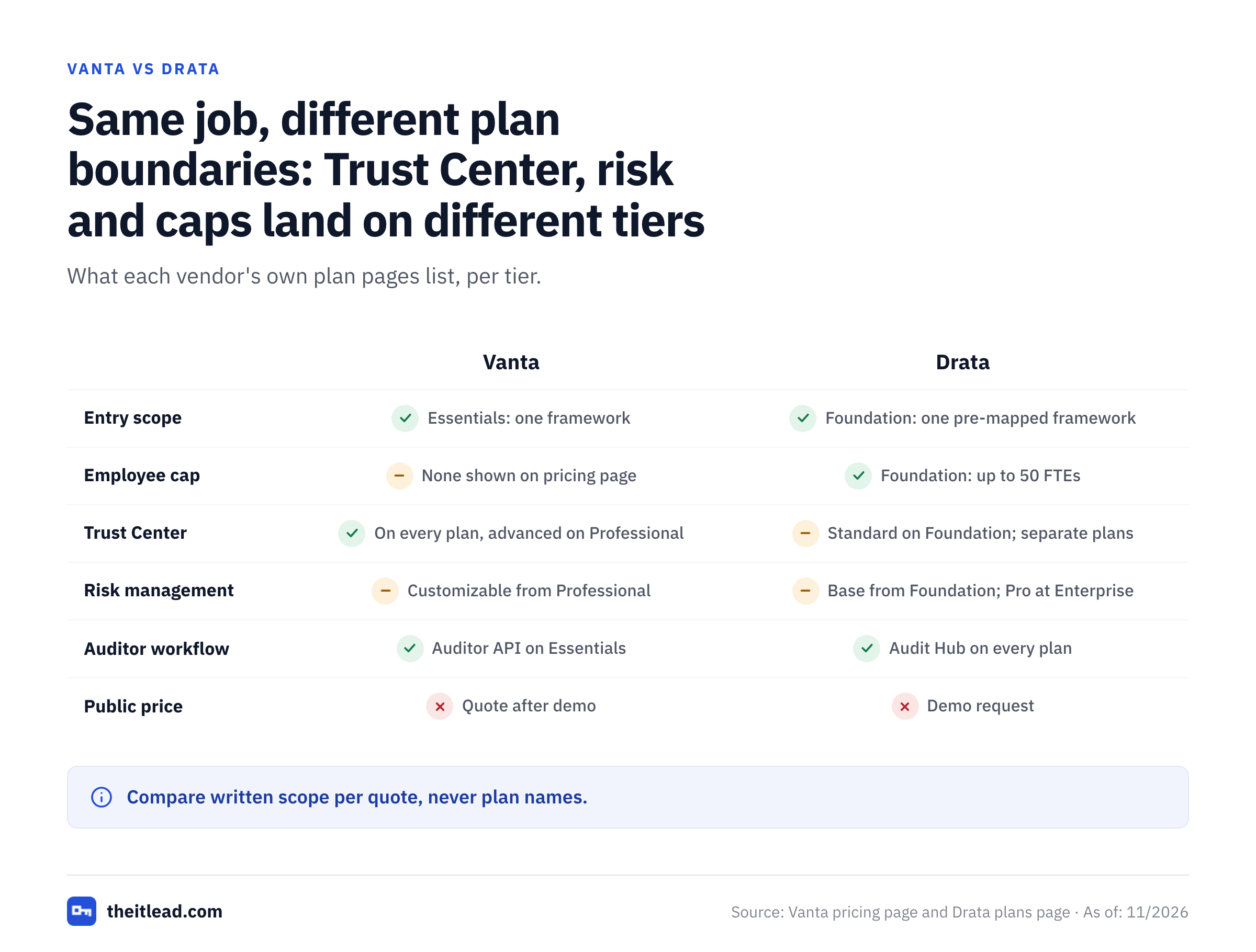
Three differences deserve attention.
Where the Trust Center lives. Vanta includes a Trust Center on Essentials and adds an advanced one on Professional. Drata gives Foundation compliance buyers a standard Trust Center, then sells a separate Trust Center product with domain caps (100, 300 or unlimited approved domains). If customers will request your SOC 2 report often, the Trust Center line item can be a large share of the deal.
Where risk management starts. Vanta puts risk management with customization, a dashboard and reporting on Professional. Drata includes base risk features from Foundation and moves the insights dashboard, custom risk scoring and risk tasks to Enterprise through Risk Management Pro. A team that needs a real risk register early may pay for different tiers on each platform.
Where the caps are. Drata publishes one hard cap: Foundation is for up to 50 FTEs. Vanta's pages show no FTE limits, but they do publish questionnaire quotas (25 and 144 a year). Neither tells you the cap on integrations per plan, so ask. It's a simple question and it's often skipped.
Which one covers more compliance frameworks?
On marketing pages, both look broad. Drata says 30+ standard frameworks. Vanta's G2 profile says it automates more than 35 frameworks, and its pricing page names SOC 2, ISO 27001, GDPR, HIPAA, HITRUST, NIST AI RMF and ISO 42001. The numbers are vendor claims, and they aren't an independent count.
A framework count tells you little, because what you need is your framework's controls mapped to tests you can pass. Drata's entry plan is explicit that you get one pre-mapped framework chosen from SOC 2, ISO 27001, Cyber Essentials, HIPAA or GDPR, and that extra frameworks are an add-on. Vanta's Essentials also covers one framework. Both therefore push multi-framework buyers up the ladder. That's where cross-framework mapping pays off: a control you test once should satisfy several frameworks without extra evidence work.
Ask each vendor to show a live mapping of your second framework against the first. If a control satisfies both, you should see the evidence reused, not duplicated.
How do integrations and continuous monitoring compare?
Vanta says it pulls data from 400+ tools and runs automated tests, with its product page describing hourly runs. Drata says 300+ integrated tools and states that control statuses are updated daily. On paper Vanta leads on both count and refresh cadence, though that's only what the vendors say.
On G2, integration breadth shows up on both sides of the ledger. Vanta's reviewers praise broad tool integrations, yet missing integrations also appears among its top complaints. Drata's reviewers list integrations among their favorite things and also name limited integrations as the top negative theme. The pattern is consistent with a simple truth: the count matters less than whether your specific stack is covered.
Build a one-page inventory before the demo: identity provider, cloud accounts, source control, ticketing, HRIS, device management and your two or three line-of-business SaaS tools. For each, ask four things:
- Is it a native integration or a custom connection?
- What minimum permissions does it need?
- Which controls and evidence fields does it actually feed?
- How often does it refresh?
A connector that exists but only covers one of your five required evidence types isn't coverage, and you'd find that out late.
- List every system in audit scope with its owner.
- Mark each as native integration, custom connection or manual evidence.
- Connect two real sources in a sandbox or read-only scope.
- Trigger one failing test and confirm who gets notified.
- Confirm refresh timing for the three most critical controls.
- Export the evidence an auditor would need for one control.
How do the auditor workflows differ?
Drata puts the Audit Hub on every compliance plan. Its product page describes centralizing auditor collaboration, evidence requests and approvals in one hub. Vanta describes planning, preparing and running audits inside the platform, tracking findings and messaging the auditor, and includes an Auditor API on Essentials.
Both promise the same outcome, a smoother audit, but the working experience depends on your auditor. Some firms prefer to work inside the vendor's portal, while others won't touch it and want exports. Ask which platforms your audit firm already uses and whether they have an existing integration.
Vendor audit-time claims are the weakest evidence in this category. Vanta's product page cites an A-LIGN spokesperson saying organizations using Vanta reduce audit completion times by 50%, and a headline claim of 82% less time per framework and attestation audit. Those are marketing statements, and the 82% figure doesn't come with a published method. Don't build a business case on them; they're clearly not independent. Instead, ask for references from companies of your size and framework mix and call two of them.
What do G2 reviewers say about each tool?
G2 is one place to see how real users rate each product. As of November 5, 2026, Drata shows a 4.7 out of 5 rating from 1,399 reviews, and Vanta shows 4.5 out of 5 from 2,897 reviews.
| Tool | G2 rating | Reviews | Top praise themes | Top complaint themes |
|---|---|---|---|---|
| Vanta | 4.5 | 2,897 | Easy to navigate, broad tool integrations, organized compliance programs | Expensive for startups, rigid workflow customization, missing integrations |
| Drata | 4.7 | 1,399 | Customer support, ease of use, compliance coverage | Limited integrations, missing features, lack of clarity |
The 0.2 point gap is small, and Vanta's pool is twice the size, so the two scores aren't directly equivalent and shouldn't decide the matter. The more useful signal is the themes. Vanta's recurring complaint is cost and rigidity, which fits a platform sold as a bundle of plans. Drata's recurring praise is support, which is worth testing during your trial by sending a real question and timing the answer.
How do Vanta and Drata pricing work?
Neither vendor publishes a dollar figure. Vanta's pricing page says to request a free demo for personalized pricing. Every Drata plan card links to a demo request. Any third-party site quoting a specific annual price for either product is quoting a sample quote or an estimate, not a list price, so don't anchor on it. Those sites can't see your scope.
What you can control is how comparable the quotes are. Send both vendors the same brief and require the same line items:
- Frameworks in scope and which are add-ons
- Employee count (FTEs) and legal entities
- Trust Center scope and domain or questionnaire quotas
- Risk management tier
- Access management or user access review scope
- Onboarding, implementation and support level
- Contract term, renewal uplift and notice period
Keep platform fees separate from your external audit fee, which you pay the audit firm and not the vendor. If a vendor offers a steep first-year discount, ask for the renewal price in writing. A deal that looks cheaper in year one can cost more by year two.
Which is better for a first SOC 2?
For a small company pursuing its first SOC 2, the entry plans are the relevant comparison: Vanta Essentials and Drata Foundation. Both cover one framework, automated evidence and monitoring. Vanta adds an Auditor API and a Trust Center on Essentials. Drata adds the Audit Hub, a standard Trust Center, base risk management and compliance as code, but caps the plan at up to 50 FTEs.
If you're under 50 people and your auditor's comfortable in a vendor hub, Drata Foundation is a clean fit. If you're nearing the cap or expect to add access management and questionnaire automation soon, Vanta's Plus tier is the closer match to where you're heading. Either way, give the same sandbox scenario to both.
Which is better for multi-framework or enterprise programs?
Once you run several frameworks, you care about reuse, custom controls and reporting across entities. Vanta's Professional plan pairs risk management, custom monitoring tests, six customizable reports and advanced control management. Drata's Advanced plan opens any available framework, custom connections and tests, and custom fields and formulas, and Enterprise adds Risk Management Pro and user access review.
Here the deciding factors are operational, and they're rarely on the datasheet. Find out who maintains custom tests and what happens to them when that person leaves. Check how exceptions get approved and when they expire. Confirm whether the platform can produce one report that covers every framework in scope. Pair the answers with a check on user access reviews, since both vendors sell that capability at different tiers; our access review software guide lists what a reviewer needs from such a tool.
- First SOC 2 under 50 employees with an auditor who likes a shared hubDrata
- You want Trust Center and questionnaire automation inside the same plan ladderVanta
- You want the Trust Center bought separately, with domain quotas you can sizeDrata
- You want access management bundled in a mid-tier planVanta
- You prefer a base risk register from the entry planDrata
- You need the widest stated integration countVanta
What should your proof of concept measure?
Don't let each vendor pick its own demo; they'll show what they're best at. Give both the same three controls, ideally ones you currently evidence with screenshots, and score the same things.
- Evidence coverage. Which of the three controls fed from live data, and which stayed manual?
- Failure handling. Break one control on purpose. How fast was it detected, who was notified and what was the remediation trail?
- Auditor view. Can your auditor see the evidence history for one control without a screenshare?
- Admin effort. How many hours did setup take your team?
- Support. Send one real question and record the response time.
- Quote clarity. Can the sales rep point to each requirement in the proposal?
Write down pass or fail criteria before the demos. If you haven't run the test yourself, don't describe one tool as faster or more accurate than the other, because there isn't an independent benchmark for these two products.
Frequently asked questions
Is Vanta cheaper than Drata?
Neither vendor publishes a price, so no public figure shows one cheaper. Request scope-matched written quotes covering frameworks, FTEs, Trust Center and risk modules.
Does Drata Foundation cover unlimited employees?
No. Drata's plan page says Foundation is for up to 50 FTEs.
Does Vanta include a Trust Center on every plan?
Vanta's pricing page lists a Trust Center on Essentials and an advanced Trust Center on Professional. Confirm the exact scope on your order form.
Can either platform replace an auditor?
No. Both automate evidence and monitoring, but an independent auditor still performs the examination and issues the report.
Which platform has better reviews on G2?
On November 5, 2026, Drata showed 4.7 from 1,399 reviews and Vanta 4.5 from 2,897 reviews. The gap is small and the review pools differ in size.
How many integrations do Vanta and Drata have?
Vanta says 400+ tools and Drata says 300+ integrated tools. Both are vendor claims, so check your specific stack.
Sources
Plan and product details come from the vendors' own pages: Vanta's pricing page and compliance automation page, and Drata's plans page and compliance page. Ratings come from the G2 profiles for Vanta and Drata. All were checked on November 5, 2026, so confirm plan names and limits against the live pages before you sign.