SailPoint vs Saviynt is a choice between two substantial enterprise identity security platforms, not a choice between governance and no governance. Both support identity lifecycle management, access requests, certification and risk-focused access decisions. SailPoint deserves a close look when you need established governance workflows across a complicated application estate or have IdentityIQ already in place. Saviynt deserves a close look when you want to evaluate identity governance alongside application-level controls and privileged access on a shared platform.
Neither vendor's current public suite page gives a universal US-dollar subscription price. A comparison that declares one cheaper without matched quotes is guessing. The decision that really matters is which product can discover your real entitlements, enforce your approval rules and prove that revoked access was actually removed.
- SailPoint: shortlist for complex certification, provisioning and IdentityIQ continuity.
- Saviynt: shortlist when application governance and privileged access belong in the same evaluation.
- Both: get a written quote tied to identity types, application scope and selected modules.
- Run the same real-world access-review and revocation test in both products before signing.
Which is better: SailPoint or Saviynt?
SailPoint is a sensible first shortlist for an enterprise that wants to modernize mature identity governance without losing sight of its existing access model. Saviynt is a sensible first shortlist for an organization seeking to evaluate IGA, application access governance and privileged access together. These are evaluation starting points, not product performance rankings.
 Choose SailPoint when
- Your access-certification and provisioning requirements span many legacy and modern systems.
- You already run IdentityIQ and need to assess cloud migration against keeping a software deployment.
- You want to evaluate the current SailPoint suites for human and non-human identities.
- You can validate remediation behavior source by source, including manual removal tasks.
 Choose Saviynt when
- You want IGA, application access governance and privileged access in one procurement exercise.
- Your evaluation emphasizes detailed application entitlements and separation-of-duties rules.
- You need to test a cloud-first identity governance operating model.
- You can confirm which capabilities are included in Essentials, Pro, Premium or specialist modules.
Ask both vendors to demonstrate the same employee transfer, the same toxic entitlement combination and the same revoked access item. If either vendor can't show the final source-system state, you don't yet have evidence of a working control.
SailPoint vs Saviynt at a glance
The comparison below separates published capabilities from the work you still need to verify in a quote or pilot. A listed capability doesn't mean it's included in the entry package.
| Tool | Core IGA | Deployment options | Current public suites | Application access governance | Privileged access | Best next test |
|---|---|---|---|---|---|---|
| SailPoint | Lifecycle, certifications and provisioning | Identity Security Cloud; IdentityIQ software option | Standard; Agentic Business; Agentic Business Plus | Evaluate policies, connectors and Access Risk Management scope | Privilege-related governance and just-in-time capabilities vary by offering | Certification through verified remediation |
| Saviynt | Lifecycle, certifications and provisioning | Cloud-native identity platform | Essentials; Pro; Premium | Dedicated application access governance offering | Dedicated PAM solution with vaulting and session controls | Fine-grained entitlement and PAM policy test |
A buying warning: A check mark in a matrix isn't an entitlement. A platform can advertise an advanced capability without including it in the package your procurement team actually buys. Put every required capability on a SKU-by-SKU quote and ask whether it's generally available for your tenant.
What do both identity governance platforms actually do?
Identity governance and administration, or IGA, links identities to the applications and permissions they need. The operating cycle begins with a reliable identity source, then moves through account creation, role changes, access requests, periodic or event-driven reviews and removal of access. A complete program also needs policy enforcement, exception handling and an audit trail.
Both vendors market lifecycle management and access governance. SailPoint's IdentityIQ documentation describes access certifications, policy management and provisioning, while its cloud offering supports certification campaigns and remediation workflows. Saviynt's IGA product describes lifecycle automation, certification campaigns and AI-assisted access decisions. Neither description tells you whether a particular disconnected application can be updated automatically in your environment.
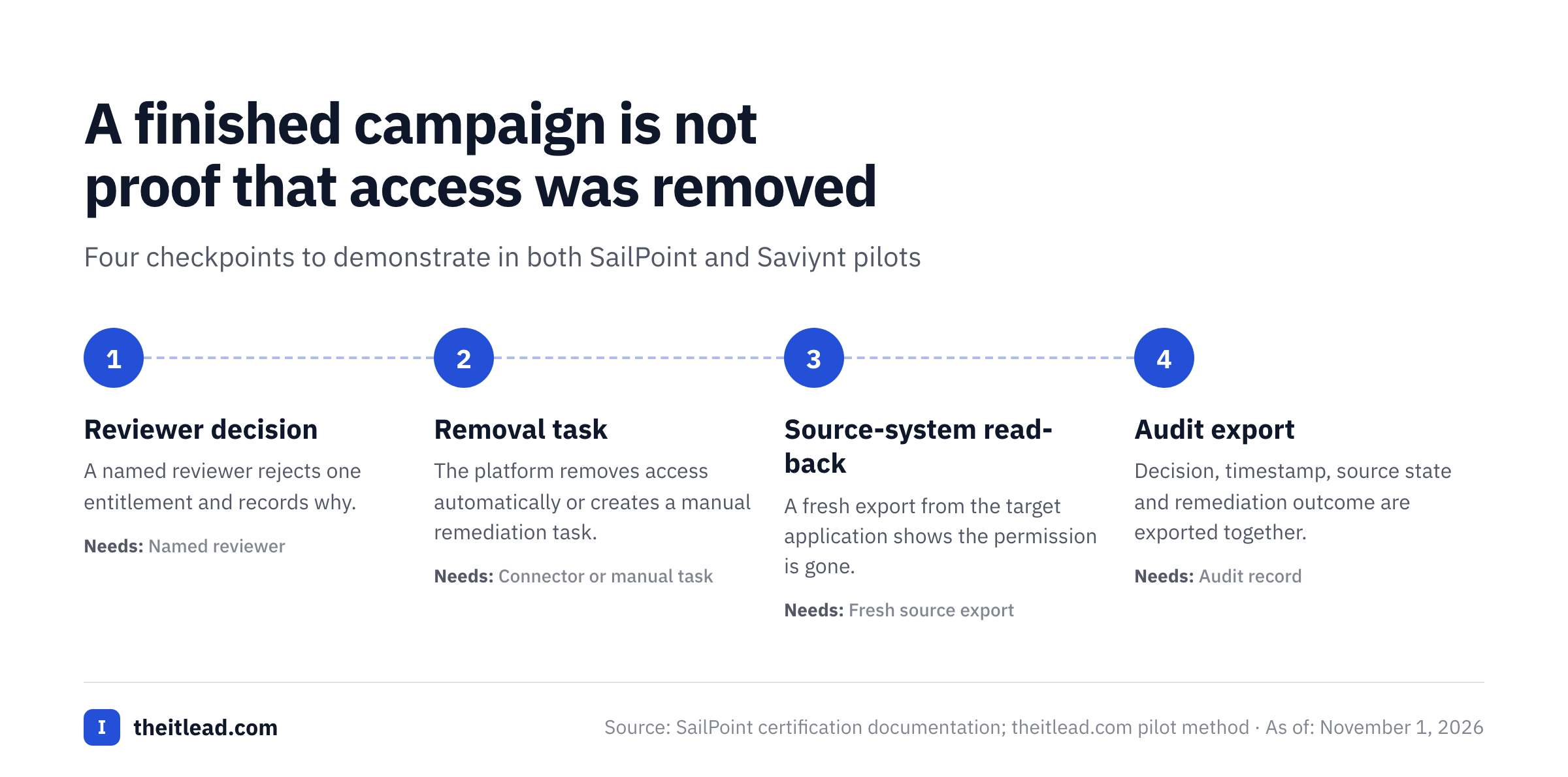
That last distinction changes how an IT team operates. A manager's approval is a decision. A connector's successful removal of a group membership is an action. A fresh export showing the permission is gone is evidence. If you collapse those into one green status, you risk signing off an incomplete review.
What a real governance workflow should look like
Imagine a finance employee moves into an operations role. The HR record changes, the identity platform detects the new assignment, the previous finance entitlements are reviewed and the employee gets only the new access that's justified. If a high-risk permission stays in place, an accountable reviewer must decide whether to revoke it. The removal should be traceable to the target application, not just to a workflow ticket.
Build your pilot around that sequence. It's the scenario auditors ask about first, and it's where weak integrations show up. Include a local application account and a privileged entitlement, not only a well-supported directory group.
How do lifecycle management and provisioning compare?
SailPoint and Saviynt both support joiner, mover and leaver workflows. SailPoint's current suites describe employee lifecycle automation, and IdentityIQ continues to support self-service requests and lifecycle events. Saviynt describes provisioning during onboarding and access revocation at departure as part of its IGA offering. The practical difference is how your chosen connectors, identity attributes and approval rules work together.
For SailPoint, check whether the cloud service can handle your required source and target systems without bespoke orchestration. If you're already on IdentityIQ, document which rules, forms, roles and integrations can move, which must be redesigned and who owns that redesign. Don't assume the cloud product's a drop-in replacement for every custom IdentityIQ implementation.
For Saviynt, test the HR-to-identity reconciliation and the resulting target-system updates. Ask how the platform handles a person with multiple assignments, a contractor with a sponsor and a local account that isn't tied cleanly to a workforce record. Then ask to see the exception queue when provisioning fails. They'll likely have one, and you'll want to know who works it. An automated happy path isn't the same as reliable lifecycle governance.
The strongest comparison uses the same source files and target applications in both pilots. Record the account state before the event, the workflow outcome, the target state after the event and the person responsible for any manual follow-up. A vendor should be able to explain every gap. If they can't, that's clearly a red flag, and you shouldn't wave it through.
Which is better for access reviews and certifications?
SailPoint and Saviynt can both run access reviews, but the important comparison is what happens after a reviewer rejects an entitlement. SailPoint's certification documentation explicitly distinguishes automatic removal on certain connected sources from manual remediation tasks when access can't be removed automatically. It also describes a remediation status report. That's a useful reminder that completing a campaign and removing access are separate control stages, and it's one reason we don't treat a green dashboard as proof.
Saviynt markets AI-assisted access recommendations and risk-focused reviews. Those capabilities may reduce reviewer effort, but you still need to inspect the policy behind an automated recommendation. Ask whether the model explains why an entitlement is low risk, whether the reviewer can override it and whether exceptions remain visible to audit.
Run the same certification test in both systems
Choose a small but representative account population. Include a current employee, a transferred employee, a former contractor, a privileged user and a service account with no clearly assigned owner. Export the starting entitlements from each target system. Then run a campaign with a manager, an application owner and a security reviewer.
For every item, record who reviewed it, what they decided and why. Revoke a permission that the connector can remove automatically. Revoke another permission that requires manual intervention. Finally, obtain a fresh source-system export. If the product shows a completed campaign while the second permission still exists, record that as an open remediation item, not a completed revocation.
SailPoint's documentation warns that undecided items need careful treatment when a campaign closes. Apply the same scrutiny to Saviynt: decide how overdue items, missing reviewers, delegates and unowned entitlements should behave before launch. Your policy should determine the default, not a hidden application setting. Reviewers won't remember an obscure default, and auditors won't accept it.
How do privileged access and application governance differ?
Saviynt has a dedicated privileged access management offering, while SailPoint's current platform and suites also describe privilege governance and just-in-time capabilities. Don't reduce this comparison to one vendor having privilege features and the other not. The correct question is which product, module and deployment provides the exact control you need.
Saviynt lists privileged access management as a specialized solution, and its PAM product page names vaulting, just-in-time access and session recording. Its application access governance offering is described as auditing and controlling user access inside enterprise applications. Those are distinct jobs: managing an administrator's privileged session isn't the same as checking whether an accounts-payable employee has conflicting approval rights.
SailPoint's Agentic Business suites describe least-standing-privilege and just-in-time access, while IdentityIQ offers governance integration for privileged accounts. Confirm whether your requested scope includes credential vaulting, session recording, emergency elevation and session termination, or whether another PAM system will still be responsible. Governance over a PAM vault isn't necessarily a replacement for the vault itself.
For an ERP-heavy environment, test separation of duties, or SoD, with a real conflict such as vendor creation plus payment approval. Verify whether the platform sees the effective permissions inside the ERP, not merely the identity's broad role label. Then trigger a conflict, request an exception and export the evidence an auditor would expect.
For a cloud-heavy environment, run a different test: request time-limited privileged access to a sensitive workload, approve it, verify the temporary grant and confirm it expires. Don't award either vendor the win until the same test passes in your environment and the required capability appears in the contract.
What about cloud deployment and existing IdentityIQ installations?
SailPoint offers cloud suites and also sells IdentityIQ, and you should confirm its hosting model in writing. Saviynt presents its enterprise identity platform as cloud-native. This matters if you've a custom on-premises identity program, regulatory hosting constraints or an application that can't be reached through a standard cloud connector.
A SailPoint incumbent should compare three paths: maintain IdentityIQ, modernize its existing deployment or migrate selected workflows to the cloud. A migration budget needs more than software licensing. Map rules, certifications, identity correlations, custom forms, role models, integration ownership and historical audit evidence. Decide which artifacts must remain searchable after the move.
A Saviynt evaluation should map the same legacy dependencies. Cloud-native delivery doesn't eliminate the need to connect older directories, ERP systems and homegrown applications. Ask the implementation team to show where an on-premises agent or gateway is needed, who patches it and what happens when it fails. Don't confuse a cloud user interface with the absence of integration work. It's still your team that'll answer the 2 a.m. page when a connector breaks.
Which platform handles AI agents and non-human identities?
Both vendors now describe governance for non-human identities and AI agents. SailPoint's current suites distinguish Standard from Agentic Business and Agentic Business Plus, with additional agentic identity governance capabilities in the latter packages. Saviynt lists non-human identity capabilities and an AI identity security offering alongside its IGA and PAM products.
The buyer's challenge isn't whether a product has an AI label. It's whether your organization can assign a responsible human owner to each agent or service account, understand the permissions it uses, limit its lifetime and revoke access when its purpose ends. Those controls need to cover API credentials, workload identities and service accounts as well as interactive users.
Ask both vendors to discover a test service account, associate it with an application and an accountable owner, display its permissions and create a reviewable attestation. Then change the owner and revoke one entitlement. Capture whether the action happened in the identity platform, in the connected system or only as a ticket. There's a big difference, and you'll want it documented. If a capability is announced but not available in your tenant, mark it as roadmap rather than live coverage.
How should you compare connectors and integrations?
Connector coverage is a source-by-source engineering question, not a single catalog count. SailPoint says its suites extend identity security to hundreds of critical applications. Saviynt says its developed connectors are included in tier pricing, while partner-developed connectors are sold separately through its exchange. Neither statement proves that the particular connector you need supports every operation.
Ask the vendor to classify each critical integration as read-only discovery, account creation, role assignment, access removal, reconciliation or full bidirectional lifecycle support. A connector that can import entitlements but can't remove them leaves a different operating burden from one that provisions and deprovisions automatically.
Create an integration acceptance register with these columns: application, identity source, connector owner, authentication method, import objects, supported write operations, error handling, refresh cadence, custom code, license dependency and evidence export. Require a real example for the applications that account for most of your access risk. They're the ones you can't afford to get wrong. Keep an explicit list of disconnected systems and their manual control owners.
Don't let a vendor answer "we integrate with SAP" without naming the SAP product, module and entitlement granularity. The same goes for Microsoft, AWS, Oracle and ServiceNow, which each cover many products and authorization models. Your application inventory is the source of truth for the evaluation.
SailPoint vs Saviynt pricing: what will you actually pay?
Neither vendor's current public packages page supplies a universal US-dollar list price for a complete enterprise deployment. SailPoint presents Standard, Agentic Business and Agentic Business Plus, with separately listed add-ons. Saviynt presents Essentials, Pro and Premium, plus specialized identity security solutions. That means a credible cost comparison needs a written, matched bill of materials.
For SailPoint, request the exact suite, licensed human population, non-human identity coverage, selected add-ons, cloud or software deployment costs, support and implementation scope. Its public suite page names Accelerated Application Management, Cloud Infrastructure Entitlement Management, Password Management and other capabilities as add-ons or package inclusions depending on the suite. Check the current contract for your entitlements.
For Saviynt, ask which tier covers your IGA requirements and whether PAM, application access governance, identity security posture management or other specialist offerings are included. Its published FAQ says Saviynt-developed connectors are included in tier pricing but partner-developed connectors are sold separately. That distinction can matter if your critical application needs a partner integration.
Compare total cost using the same worksheet
| Cost line | SailPoint quote | Saviynt quote | Evidence to request |
|---|---|---|---|
| Core identity licensing | Vendor quote | Vendor quote | Counted identity types and contract term |
| Advanced governance | Suite and add-ons | Tier and specialist modules | Feature-to-SKU mapping |
| Non-human identities | Package capacity and extra coverage | Package and specialist coverage | Included quantity and overage rules |
| Application connectors | Included and custom integration scope | Vendor and partner connector scope | Named connectors and write operations |
| Implementation | Services statement of work | Services statement of work | Named systems, milestones and acceptance tests |
| Ongoing operations | Internal staff and partner support | Internal staff and partner support | Runbooks, upgrades and support ownership |
| Exit or migration | Export and transition terms | Export and transition terms | Data formats, assistance and notice clauses |
A lower subscription quote can become a more expensive program if it leaves a large set of manual application reviews. The reverse is also true: a more capable suite isn't good value when you won't use its advanced modules. Compare the annual subscription, the implementation statement of work and the ongoing control effort separately. Finance teams often see only the first line, so you'll need to show the rest.
A practical SailPoint vs Saviynt proof-of-concept plan
The best evaluation uses a short, controlled set of real workflows and a shared scoring rubric. It's better to test a small population thoroughly than to sit through a broad demonstration with no source-system evidence. Give both vendors the same anonymized identity records, entitlement exports and success criteria. That's the only way the results are certainly comparable.
- Agree on the same identity types, source applications and target systems for both vendors.
- Reconcile a new hire from the authoritative HR record to a target account.
- Change an employee's role and verify removal of obsolete entitlements.
- Submit a request that violates a separation-of-duties rule and capture the policy result.
- Run a certification campaign with named reviewers and a delegated reviewer.
- Revoke one connected entitlement and confirm the target-system state.
- Revoke one disconnected entitlement and trace the manual remediation queue.
- Test time-limited privileged access where the quoted product supports it.
- Review a service account with an accountable owner and documented business purpose.
- Export evidence with reviewer, decision, timestamp, source state and remediation outcome.
- Simulate an integration failure and inspect alerts, retries and operator ownership.
- Get the feature-to-SKU mapping and implementation statement of work in writing.
Score what the IT team can verify
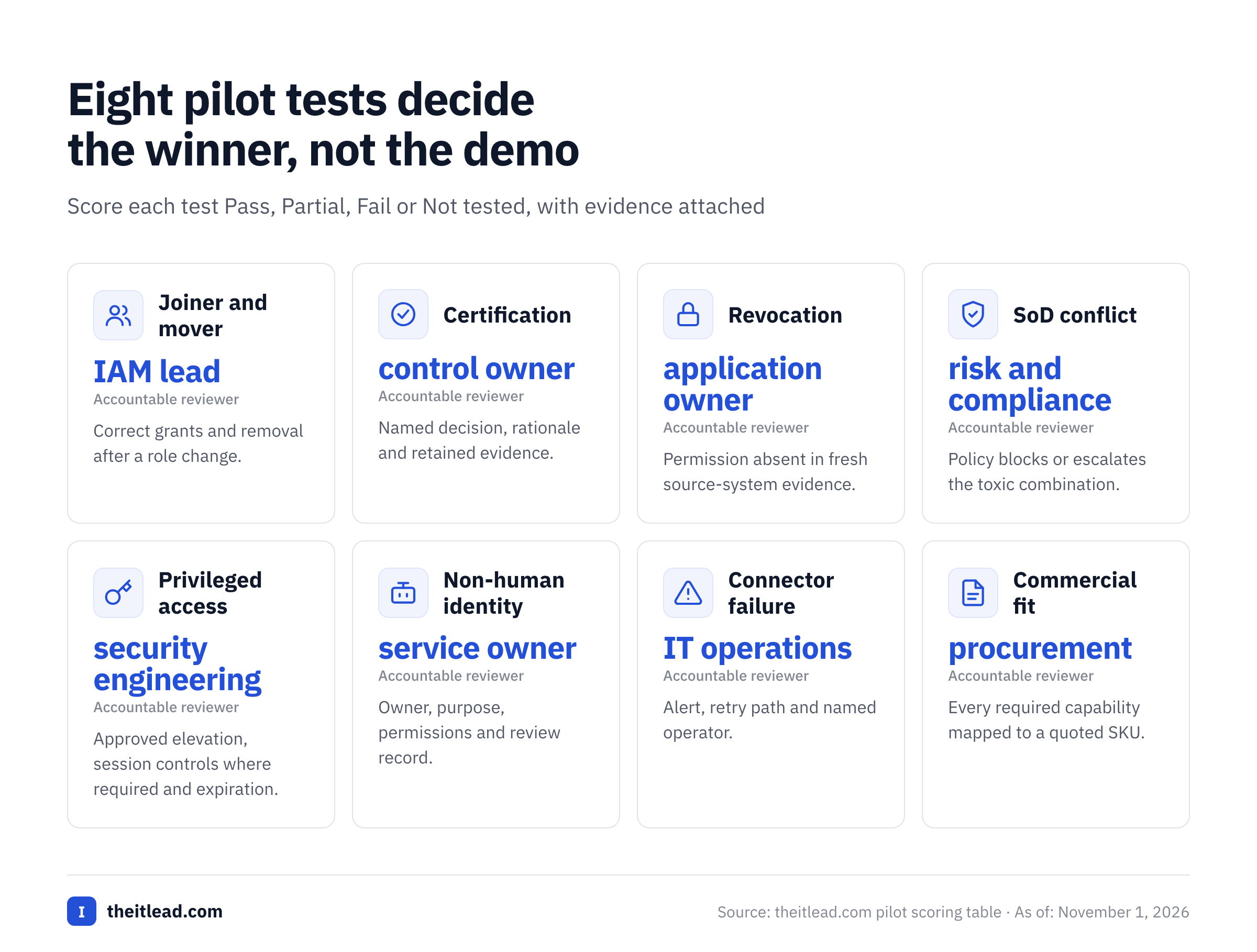
Use a shared scale such as Pass, Partial, Fail or Not tested for each control. A pass means the vendor demonstrated the result in your target system with the required audit record. Partial means an action was manual, the evidence was incomplete or a required module wasn't in the pilot. Not tested stays not tested. Don't convert it into a pass based on a roadmap slide.
| Test | What counts as a pass | Accountable reviewer |
|---|---|---|
| Joiner and mover | Correct account grants and removal after a role change | IAM lead |
| Certification | Named decision, rationale and retained evidence | Control owner |
| Revocation | Permission absent in fresh source-system evidence | Application owner |
| SoD conflict | Policy blocks or escalates the specified toxic combination | Risk and compliance |
| Privileged access | Approved elevation, session controls where required and expiration | Security engineering |
| Non-human identity | Owner, purpose, permissions and review record | Service owner |
| Connector failure | Alert, retry path, named operator and reconciled outcome | IT operations |
| Commercial fit | Every required capability mapped to a quoted SKU | Procurement |
After the pilot, rank requirements as mandatory, important or optional. Any failed mandatory control should trigger remediation or a different architecture, even if the product has the prettier interface. A scoring spreadsheet helps only when the evidence behind each cell is retained. If it isn't attached, it didn't happen.
Where does each vendor win?
- Existing IdentityIQ estate needs a carefully scoped modernization pathSailPoint
- Certification and provisioning are the center of the procurementSailPoint
- Dedicated application access governance is a leading evaluation requirementSaviynt
- IGA and a dedicated privileged access product are being evaluated togetherSaviynt
The four rows above are shortlisting signals, not an empirical head-to-head performance verdict. Both vendors have non-human identity offerings, and neither wins on price without a matched quote. Your pilot evidence should override any row that doesn't match your architecture.
Where does service account ownership fit?
Identity governance suites are designed for broad enterprise identity controls. Some teams still need a narrow, practical workflow for documenting who owns each service account and whether its access is justified. That isn't the same as credential rotation, directory synchronization or automated account disabling.
For an IT lead building a service account evidence process before a large IGA rollout, a CSV-based ownership register can establish a baseline: import accounts, nominate an owner, collect attestations and retain an audit trail. That's the limited workflow addressed by this site's service account ownership review product. It shouldn't be represented as a replacement for SailPoint, Saviynt or a privileged access vault.
If you're building the evidence process now, use the service account ownership reviews workflow as a starting point.
If you aren't ready for an enterprise IGA procurement, start by naming owners and capturing evidence. If you're already comparing enterprise suites, use the same ownership register as a pilot input and check how each vendor handles orphaned service accounts.
Frequently asked questions
Is SailPoint better than Saviynt?
Neither is universally better. SailPoint is a strong shortlist for established enterprise governance and IdentityIQ continuity. Saviynt is a strong shortlist when application access governance and PAM are part of the same evaluation. Validate the winner against your applications and controls.
Is Saviynt cheaper than SailPoint?
A reliable public price winner isn't available from the vendors' current packages pages. Ask for matched quotes covering identity types, modules, connectors, implementation and support.
Does SailPoint support on-premises deployments?
SailPoint sells IdentityIQ alongside its cloud suites, but its public IdentityIQ page doesn't spell out the hosting model. Ask SailPoint in writing which deployment, upgrade and support terms apply to the version you're considering.
Does Saviynt include privileged access management?
Saviynt offers a dedicated privileged access management solution. Check whether the quoted suite includes the exact PAM capabilities you need or whether a specialist module is required.
Can both tools automate access reviews?
SailPoint and Saviynt both support certification workflows. The meaningful distinction is how each handles reviewer decisions, unresolved items, connector limitations, remediation and final evidence in your environment.
Which is better for non-human identities?
SailPoint and Saviynt both market non-human identity governance. Compare ownership assignment, discovery, entitlement visibility, access reviews and the actual licensed package rather than relying on an AI label.
What should I test first in a SailPoint vs Saviynt pilot?
Start with one role change and one revoked entitlement. Prove the final access state in the target application, then expand to SoD, privileged access, non-human identities and failure recovery.
The decision rule: Choose the platform that passes your mandatory controls, shows the least unresolved manual work and provides a contract that matches what you tested. Keep the proof-of-concept evidence with the signed scope. The winning product is the one your IT team can operate and audit after the sales team leaves.